

My brother sent me a Wall Street Journal article last year. I can’t find the article right now, but it’s good that I jotted down the summary.
The article is more valid since it stood true during the “Liberation Day Crisis.”
Here, author Jason Zweig offers some profound advice for this volatile market, which creates a fight (Buy more), flight (sell), or freeze (do nothing) reaction.
Instead, consider the following four key questions, which will help guide your decision-making:
The first, two-part question paraphrases an expression that the renowned former manager of the Fidelity Magellan Fund, Peter Lynch, has often used.
1. What do you own, and why do you own it?
Meet with your financial advisers or, if you manage your own money, update your measure of how much of your portfolio is in each broad category of assets. You can’t decide whether or not to sell if you don’t know precisely what and how much you own. (With the S&P 500 down more than 10% this year, you may be less overexposed than you were a few months ago.)
If you must panic, panic methodically.
Long ago, you should have set a target for how much of your portfolio you wanted in large U.S. stocks. If you’re above that threshold, rebalance by selling large U.S. stocks and allocating the proceeds to smaller U.S. companies, international stocks, bonds, and other assets. Do this in your tax-advantaged retirement accounts first to avoid triggering capital gains.
2. Why do you own stocks?
Do you own them primarily because you wanted to benefit from the stability of longstanding trade agreements between the U.S. and the rest of the world? Probably not. Most likely, you’ve always owned stocks because you wanted to participate in the long-term growth of the U.S. (and global) economy.
3. What has changed in your situation or the market?
There’s no doubt that Trump’s trade moves have damaged much of the rest of the world’s trust in the U.S. Just look at how the U.S. dollar and Treasury bonds have slumped since March.
But people, companies, markets, and countries are remarkably resilient. They will bounce back—although anyone who claims to know how long that will take is either a liar or a fool.
And markets might not recover on the timeline you need. Look inward: If you’re in or near retirement, you can’t wait years or possibly even decades, as full market recoveries have sometimes taken in the past. Moving equal monthly increments of your U.S. stock assets into inflation-protected bonds, which should still provide a stream of income that stays constant despite rising inflation, can make sense.
4. If you didn’t already own this asset, would you buy it at this price?
Beware of what behavioral economists call anchoring. That’s the tendency to measure your gains and losses against a vivid, recent reference point rather than against what matters: the price you originally paid.
Take Apple, for instance. From April 2, 2025, when Trump announced his tariff plan, through April 8, 2025, the stock fell 23%; by then, it was down 31% for the year. But if you’d originally bought it 10 years earlier, you’d still have a gain of more than 500%; if you’d bought it five years ago, you’d still be up over 160%.
How often are the declines?
Know the Bears:
5% to 10% declines are super common. You’ll see one or more of these declines in an average year.
20% decline: Expect one to two within a five-year period
30%, 40%, and 50% declines are progressively less common, but do still occur.
Most 20% declines are good buying opportunities because there are many of them, but relatively few go on to become declines of 25% or more.
Bounce Back stats of Bulls:
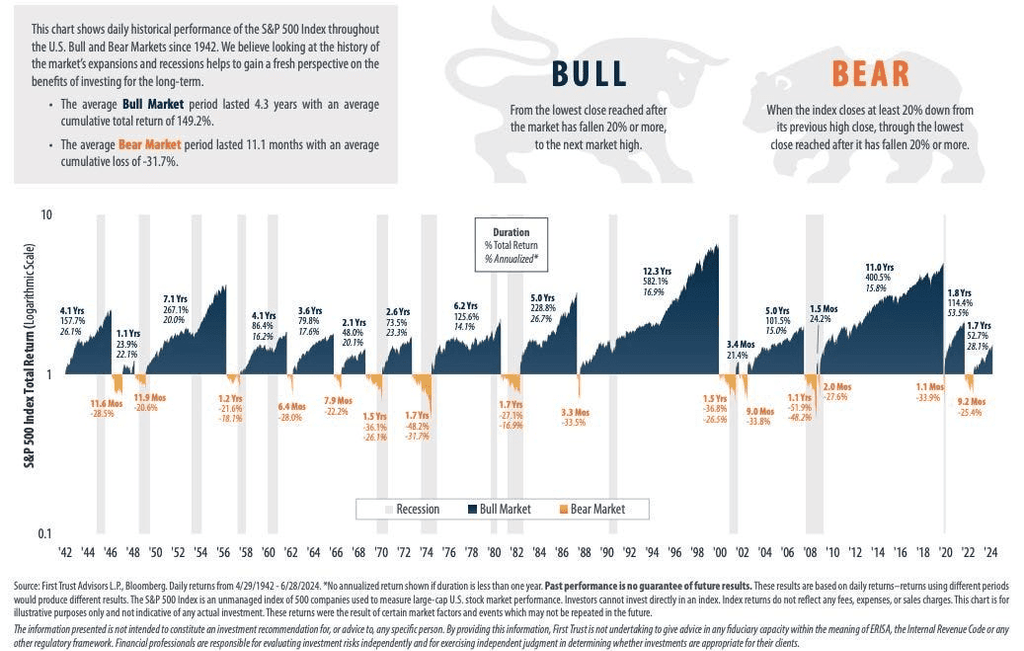
Notice the picture above: the bears have a short run.
5 years: Market rebounded every time; average gain 97%.
3 years: 16 out of 19 times, average gain 37.5%.
1 year: 17 out of 19 times, average gain 12.5%.
My Mantra:
In a world of fight, flight, or freeze, I’m choosing a fourth option: acting like I have a plan.